
2027 Budget
Every year, the Town of Georgina passes a budget to determine how funds are allocated. The Town is committed to developing a responsible budget to ensure it balances the needs of a growing town while maintaining high-quality municipal services. Property taxes go towards a variety of programs and services which families rely on and use every day, including road work, snow clearing, garbage collection, fire and rescue services, and recreation and culture programs.
Community engagement
Your feedback is vital to shaping the budget process. Below are the various ways you can get involved:
- Budget engagement platform
Visit the new budget engagement platform and take part in the Community Priorities Challenge which provides residents an opportunity to distribute a fictional $100 throughout municipal services based on what matters most to them.
2. Community events
Town staff will be available to address any questions or comments you may have.
Oct. 3, 2026 – MURC – 9 a.m. to noon
3. Budget survey
The budget survey is open until Oct. 3, 2026. Your input is appreciated and will help determine the Town’s key priorities for the 2027 budget. Provide your feedback for a chance to win a $100 gift card.
4. Public information session
Residents are invited to attend a public information session at the Council Chambers on Nov. 3, 2026 from 7 p.m. to 8 p.m.
Budget timeline
The proposed budget will be released to Council, the Clerk and the public in early 2027.
Contact us
Email any questions and feedback to budget@georgina.ca.
Budget approval process under Bill 3, Strong Mayors, Building Homes Act, 2022
Bill 3, Strong Mayors, Building Homes Act, 2022, received Royal Assent on Sept. 8, 2022, and was added to the Municipal Act as Part VI.1 – Special Powers and Duties of the Head of Council. On Aug. 21, 2023, the Ontario government announced it was extending strong mayor powers to 21 municipalities, including the Town of Georgina, that have projected to have populations of 50,000 or larger by 2031, and that have committed to meeting the assigned provincial housing targets. On Oct. 31, 2023, strong mayor powers were extended to the Town of Georgina.
The bill extends the mayors of the designated municipalities special powers and duties including, among others, the power to propose the municipality’s annual budget, subject to Council amendments, a mayoral veto, and a Council override process as defined under O. Reg. 530/22. These powers cannot be delegated.
Under Bill 3, Strong Mayors Act described below, the budget approval process under this framework is as follows:
- Council has 30 days to propose amendments to the Mayor’s proposed budget, and if no amendments are presented, the Mayor’s proposed budget is deemed to be adopted.
- The Mayor may veto Council amendments within 10 days after the time period for Council to pass amendments. If the Mayor does not exercise the veto power, the amended budget is deemed adopted.
- Council may override the veto with a two-thirds majority vote within 15 days after the time period for the Mayor to veto an amendment, in which case the amended budget is considered adopted.
- If Council does not override the Mayor’s veto, the proposed budget is considered adopted.
Frequently asked questions for the 2026 budget
How much will my tax and water bills go up based on the proposed increases?
For households on water and wastewater services, the proposed increase at 9.3 per cent will result in a quarterly bill of approximately $350, based on the average usage of 41 cubic metres per quarter.
Why do we need a stormwater fee and how much can I expect to pay?
Stormwater fees are crucial because they provide a dedicated source of funding for maintaining and improving stormwater infrastructure. The 2026 stormwater rate is a 2 per cent increase over the 2025 rate, with the average bill at approximately $165 per year for the residential property class tax category (RT).
Is there a tax levy increase for the replacement Civic Centre in the 2026 budget?
There is no tax levy increase relating to the replacement Civic Centre in the 2026 budget. The funding for the construction of the replacement Civic Centre was established during the 2023 and 2024 budget process and there will be no additional tax levy increases required for this project.
Why has the Town hired so many new positions over the past five years?
Georgina is a growing municipality. New positions generally are a result of legislative, service level or growth-related impacts. More than 50 per cent of positions hired over the past five years are directly related to growth and were funded by growth-related revenues, such as assessment growth, with no tax levy increases.
Is the 1.25 per cent infrastructure levy in 2026 really necessary, or is it just building up large reserve funds?
What does the municipal portion of my 2026 taxes pay for?

- $0.22 - Community Services
- $0.18 - Contribution to Reserve - Capital Infrastructure delivery
- $0.15 - Fire and Rescue Services
- $0.12 - Operations and Infrastructure
- $0.11 - Corporate Services
- $0.06 - Georgina Public Library
- $0.06 - Contributions to Reserve - Operating and Growth
- $0.03 - Office of the Deputy CAO
- $0.03 - Office of the CAO
- $0.02 - Development Services
- $0.01 - Town Solicitor
- $0.01 - Office of Mayor and Council
Information Videos
Explore our videos to learn more about property taxes, assessment growth, the services we provide, and our 10-year capital plan.

Frequently asked questions
What makes up the budget?
A municipality’s budget is made up of:
- Operating budget covers the day-to-day expenses of running the municipality. The operating budget focuses on delivering the consistent, reliable services that residents and businesses expect. The financial decisions we make today are critical to the long-term sustainability of the Town.
- The Town’s capital budget covers large infrastructure and other long-term projects. The 10-year Capital Financial Plan is an updated financial plan to ensure the Town can fully fund its 10-year capital plan.
- Reserve funds act as a savings account, to set funds aside for cyclic costs like elections and for planned capital costs.
- There are other components that are included in the Town's budget, such as:
- Debt financing
- Assessment growth
- Development charges
Where does the Town get the money to pay for its ongoing wide range of services?
The Town of Georgina, like most Ontario municipalities, uses a variety of revenue and funding sources to pay for a wide range of services.
- Property taxes – Largest source of municipal revenue, this is calculated by applying the municipal tax rate by the property assessment as determined by MPAC.
- User fees – These fees are paid for by the specific user or group of users, including visitors and non-residents, rather than property owners through the municipal tax base.
- Water and wastewater rates – Water consumption and wastewater usage charges are based on how much water a property uses. Consumption is measured by the water meter.
- Stormwater rates – A reliable and sustainable approach to stormwater management. A charge levied on property owners to maintain stormwater infrastructure.
- Grants – Funding received by government grants to fund operating activities makes up only a small part of the municipal budget. It is important to ensure the municipality can operate on its own without reliance on other levels of government.
- Other – Miscellaneous revenues such as permits and licences.
Why does the Town use long-term debt?
In Georgina, long-term debt is not taken on casually or reactively - it’s been planned for many years as part of a disciplined financial strategy.
As far back as 2016, the Town completed its first 20-year long-range financial plan that identified the need for approximately $105 million (2016 dollars) in additional debt, on top of about $11 million already in place at the time, to support critical infrastructure and community investments. That initial plan, together with further financial plan updates based on our asset management plans, development charge background studies, master plans and annual budgets, has guided our decisions ever since.
The reason we use debt comes down to timing, affordability and stability. Large infrastructure projects can’t always wait until funds are fully accumulated and debt allows us to deliver those projects when they’re needed while spreading costs over time. Importantly, different types of projects are supported by different revenue streams as described below.
-
About 59 per cent of the 2025 existing debt is funded through development charges. These are growth-related funds used for major projects like the Multi-Use Recreation Complex (MURC). The MURC was financed over 25 years to ensure the debenture repayments aligned with the forecast growth and associated development charge revenues. The need for the MURC was identified through the 2014 Recreation Needs Assessment and was further included in all future development charge background studies to ensure that population growth and service level needs are aligned. While development charges are collected over time, they are also regulated and capped. Using debt allowed the Town to build the facility when the community needed it. If we had waited to fully collect those funds, recreation services would have continued to decline relative to population growth and the cost of construction would be much higher today due to high inflation over the past few years, which would have limited the Town’s ability to utilize development charges to fund this growth-related facility.
-
Roughly 32 per cent of the 2025 debt is supported by the tax levy, primarily for projects like the Link, Pefferlaw Fire Hall and Replacement Civic Centre. Based on several years of proactive financial planning, it was possible to finance the Replacement Civic Centre debenture over a period of only 10 years rather than the original 30-year plan.
-
The remaining nine per cent of debt is funded through water and wastewater rates. The rate studies and asset management plans identified critical infrastructure that needed to be replaced, some of which was already experiencing failures. Using debt allowed the Town to proceed with proactive replacements while avoiding double digit increases in water rates. It was also considered that reactive repairs can cost two to three times more than planned, proactive work.
At its core, debt is used for long-life assets, things like facilities, water pipes and roads that will serve the community for decades. It allows the Town to align costs with the lifespan of those assets and the residents who benefit from them, while keeping taxes and rates stable and predictable.
Every borrowing decision is carefully modeled and reviewed annually to ensure The Town remains well within provincial regulations and the Town’s own financial limits.
How much debt does the Town have and how is it funded?
At the end of 2025, Georgina had approximately $85 million in existing debentures. Of that amount, about $49.8 million was funded through development charges, $27.5 million through the tax levy and $7.7 million through water and wastewater rates.
In addition, prior to the 2026 budget, the Town had approved another $21.7 million in debentures. That included approximately $10.4 million funded through the tax levy for burying hydro lines and other streetscape improvements on High Street and construction of the Old Shiloh Bridge, $10 million through water and wastewater rates for various infrastructure replacements, and $1.3 million through development charges for the South Keswick Fire Hall Design.
Through the 2026 budget process, a further $20.8 million in debt was approved, with $15.3 million funded through development charges for the South Keswick Fire Hall construction and $5.5 million through water and wastewater rates for various infrastructure replacements.
Combined, the Town’s total existing and approved debt to be taken out is approximately $127.5 million.
It’s important to note how debt is structured and funded. About $66.4 million - just over half - is funded through development charges, meaning growth is helping to pay for growth-related infrastructure. Approximately $23.2 million is funded through water and wastewater rates, directly tied to those systems and services. The remaining $37.9 million is funded through the tax levy.
This means the Town’s debt is not solely carried by property taxpayers, it is allocated across different funding sources depending on the type of infrastructure being financed.
It’s also worth noting that debt levels decline over time as repayments are made. Based on current projections, the balance of the Town’s existing and approved debt is expected to decrease to approximately $64.3 million by 2036. This is broken down with $42.9 million being funded by development charges, $11.4 million by tax levy and $10 million by water and wastewater rates. The significant reduction in tax levy supported debt is due to the Replacement Civic Centre debenture of $20 million being fully repaid within 10 years.
What is an Annual Repayment Limit (ARL) and how is it calculated?
The Annual Repayment Limit, or ARL, is a key financial measure used to determine how much debt a municipality can responsibly carry. In simple terms, it represents the maximum amount the Town can pay each year toward principal and interest on long-term debt and other long-term financial commitments.
In Ontario, the Province sets the standard ARL at 25% of a municipality’s own-source revenues. These revenues include things like property taxes, user fees, and investment income, but excludes development charge revenues. The calculation starts by determining the Town’s annual own-source revenue, then calculating 25% of that amount. From there, existing annual debt payments and other long-term financial obligations are deducted to determine the remaining borrowing capacity.
In Georgina, we’ve chosen to be even more conservative than the provincial standard. Council has established an internal ARL target of 15%, well below the Provincial 25% limit. This provides an added layer of financial discipline and helps ensure we maintain flexibility and long-term financial stability.
For 2026, Georgina’s ARL utilized is projected to be around 10% of net revenues, with forecasts showing it may peak around 12% to 14% in 2027 before beginning to decline significantly over the next decade. That means even at its highest projected point, the Town remains below both the provincial limit and our own more conservative internal threshold set by Council.
This is important because it shows that the Town’s use of debt is planned, measured, and within manageable levels based on our long-term financial strategy.
Where do my taxes go?
Your property taxes are used to fund programs and services at the Town, regional and provincial level.
Town services
- Animal services
- Fire and rescue services
- Georgina Public Library
- Licences and permits
- Infrastructure replacement
- Maintenance of Town facilities
- Municipal law enforcement and by-laws
- Office support and administration
- Parks, sports field and beaches maintenance
- Recreation and culture services
- Roads services
- Snow removal on local roads and sidewalks
- Town planning and development
- Waste collection
Regional services
- Maintenance of main/major roads, sewers and bridges
- Public health services
- Regional planning and growth management
- Regional waste disposal
- Snow removal on regional roads
- Social assistance
- Social housing
- Traffic planning on regional roads
- York Regional Police
- York Region Transit and Viva services
Province of Ontario
- Education
What is the difference between assessed values and market values?
The assessed value of your house is calculated by MPAC and is based on numerous factors, including location, amenities available, lot size, house size, property sales and overall details of the house. This assessed value is then multiplied by the tax rate to arrive at the property taxes charged by the municipality.
The Market value is the price you would get for your property should you decide to sell; the market value will fluctuate throughout the year and is typically higher than your assessed value. A property's market value has no direct influence on the taxes of a property and is not a reliable method to calculate the taxes on a property.
How are property taxes calculated?
The Municipal Property Assessment Corporation (MPAC) sets the assessed values for all properties in Ontario. These assessed values are provided to the Town and are updated yearly. To calculate your property taxes, we multiply your assessed value by our tax rate.
For example:
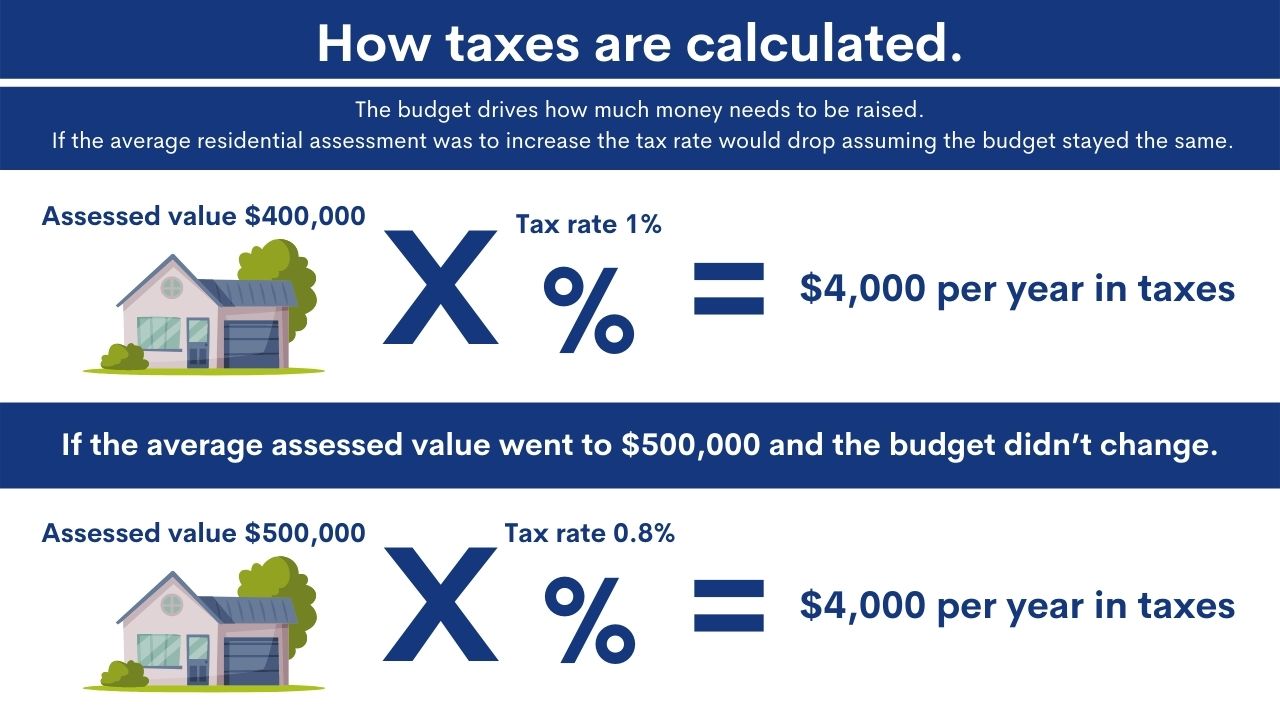
MPAC typically reassesses property on a 4 year cycle, however due to the impacts of COVID-19 the last reassessment was not conducted. Properties are still being assessed using the same values that they were in 2020. If properties are reassessed at a higher value it does not necessarily mean that there will be an increase in taxes.
How does the budget impact property taxes?
The budget sets forth the amount of money each year that the municipality must raise in order to meet the objectives within the budget document. The main way of raising these funds is through the property tax levy. The Town of Georgina is a lower-tier municipality, meaning taxes paid for your Georgina property also go to York Region and the Province for the education levy. Approximately 54 per cent of taxes paid go to Georgina. Since Georgina is a lower tier, a budget increase from Georgina will only impact the Georgina portion of your bill.
How do Georgina’s tax levy increases compare to inflation in Ontario?
Over the past 10 years, Georgina’s average annual operating budget levy increase has been 2.56%, compared to an average Ontario CPI increase of 2.71%, reflecting the Town’s commitment to balancing affordability with the delivery of municipal services.
Although the Town’s annual operating levy increases do not always align directly with inflation in any given year due to factors such as multi-year contracts and collective agreements, over longer periods such as 5 and 10 years, the average increases in operating costs generally align closely with inflation, as shown in the table below.
In addition to the operating levy, the Town has implemented a dedicated capital infrastructure levy to help address long-term infrastructure funding needs and maintain municipal assets in a state of good repair. Over the past 10 years, the average annual infrastructure levy increase has been 1.27%.
The infrastructure levy has evolved as the Town has strengthened its asset management practices through condition assessments, lifecycle planning, and compliance with Ontario Regulation 588/17: Asset Management Planning for Municipal Infrastructure. Initially established at approximately 1%, the levy was temporarily reduced during the COVID-19 pandemic to recognize the financial pressures facing residents and businesses.
The levy was increased to 2% in 2023, 2024, and 2025 in response to unprecedented increases in infrastructure construction costs. For example, the Ontario Non-Residential Building Construction Price Index increased by 15.3% in 2021, 14.5% in 2022, and 5.4% in 2023, reflecting sustained inflationary pressures in the construction sector.
Following completion of the Town's Asset Management Financial Plan and refinement of its long-term infrastructure funding strategy, the dedicated infrastructure levy was reduced in 2026 and is now set at 1.5% moving forward.
The following table summarizes the Town’s annual operating levy increases, capital infrastructure levy increases, and Ontario CPI rates over the past 10 years, providing context on how levy decisions have evolved in response to changing service, infrastructure, and economic pressures.

How can I view the assessed value for my home?
Did you know that assessed values are public information? You can view the roll book located at the Civic Centre or you can view assessed values online at georgina.ca/TaxandWaterPortal.
What are assessment growth and development charge revenues?
Assessment growth refers to new taxes collected from newly constructed or expanded homes and businesses to fund the Town services they receive (operating budget costs). Development charges, on the other hand, are fees levied by the Town on new development projects – such as residential, commercial and industrial buildings – to help pay for the new infrastructure needed (capital budget costs). Development charges are typically paid by developers at the time of building permit issuance. The MURC is a prime example of “growth paying for growth,” as there was no tax levy impact for existing residents in terms of either operating or capital expenditures for this facility.
This was made possible through strategic financial planning and careful allocation of revenues from assessment growth and development charge collections.